Previsão e Seguimento de Furacões (Atlântico 2025)

  • Thread starter Thread starter Orion
  • Data de início Data de início
Continua difícil a existência de Gabrielle como ciclone tropical, mas a previsão aponta para conseguir chegar a furacão dentro de 2 a 3 dias:


J92Dnkc.png


De resto, o mês de pico na actividade de ciclones tropicais mantém-se fraco, muito fraco mesmo.
Mais uma tentativa de formação a sair da costa africana, com probabilidades baixas (20%), ainda por cima vai na esteira de Gabrielle
GTWO-7D_20250919-06.webp
 
Última edição:
Foi o primeiro ciclone que me lembro ... Furacão Charlie ...

Pela Terceira ainda fez os seus estragos ...

Lembro me perfeitamente de na altura eu e a minha mãe nos refugiarmos na casa de uma vizinha e de todos os vizinhos ficarem juntos com o receio de algo pior ...

Lembro me de um vizinho que vinha da rua nos relatar que várias estradas estavam cortadas ...

Foi a primeira vez que senti aquela sensação de que algo grande estava a vir ...

A segunda vez foi no Furacão Tânia em 1995 no que para mim foi o pior furacão de que tenho memória a afetar a Terceira ...

Lembro me perfeitamente de estar com a minha mãe a segurar as portadas durante a noite pois parecia que tudo ia levantar voo ...

Foram tempos animados esses ...

Claro que depois houve o Lorenzo que afetou algumas ilhas de uma forma inédita mas curiosamente na Terceira a coisa foi mais calma porque a tempestade afetou mais o grupo ocidental e o sul do grupo central ...


Recordo bem do Charlie... e do Bonnie que veio logo a seguir.
Estávamos em 1991 ou 92 se não me falha a memória.
O Charlie bateu forte no grupo Oriental, mas também o Bonnie que para mim foi o pior.
Foi o furacão mais recente em tempos cronológicos que me recordo que mais impacto fez na Ilha de São Miguel, mas também o Tânia que foi completamente assustador com muitos prejuízos materiais.
Nessa altura não haviam redes sociais nem internet e cada um ficava à conta de nosso senhor...apenas seguiamos os avisos pela TV e pelo rádio, mas lembro que nessa altura as pessoas encaravam isso como uma coisa normal sem o sensacionalismo exagerado de hoje em dia.
Lembro de ver telhados a voar e árvores arrancadas, quer no Bonnie, quer no Tânia.
As vagas entravam sem piedade pelos quintais das moradias que ficavam na orla costeira....
Meus avós contavam me que no tempo deles ( inícios do séc XX) os furacões eram bastante piores com consequências maiores do que hoje em dia.
Até no Inverno era costume ver as serras mais altas da ilha cobertas de branco semanas a fio..
Hoje em dia é raro já isso acontecer....
Muitas pessoas ficavam sem as suas casas, n havia subsidios para dar a ninguém, os pastores tinham que acautelar o gado em zonas altas e muitos deles desapareciam sem rasto com o temporal em profundas grotas e ravinas sem ser notícia...
Calhaus gigantes que entravam por terra dentro com a força do mar.. cemitérios fronteiriços ao mar que ficavam inundados de água , e a lista nunca mais acabava...

Minha mãe é da década de 50 do séc XX e é a própria a dizer que antigamente as estações eram bastante mais definidas, as tempestades tropicais e os invernos eram muito mais rigorosos que hoje...
O ciclone mais destrutivo que me recordo no grupo Oriental foi no Natal de 1996, a ilha de São Miguel foi atingida por uma grande tempestade, que causou o encalhe de navios na marina de Ponta Delgada, nos dias 25 e 26 de dezembro. Deve ter sido um ciclone fora da sua época normal.
Além disso, a 14 de Dezembro desse mesmo ano, um evento de mau tempo com chuva intensa, provocou deslizamentos de terra e cheias na vila da Povoação, que resultou em vítimas mortais e muitos estragos..
Se formos fazer uma perspectiva ao passado de todos os ciclones que já atingiram os Açores nunca mais saíamos daqui, por que a lista é infindável...
Mas uma coisa é certa: já não há verões nem invernos como antigamente, e isso é geral nos Açores, de uma ponta à outra do arquipélago...

 
Última edição:
Mas uma coisa é certa: já não há verões nem invernos como antigamente, e isso é geral nos Açores, de uma ponta à outra do arquipélago...

Quais são concretamente as diferenças em relação aos de "antigamente"?

É preciso também realçar que a percepção das tempestades (ciclones tropicais ou meras tempestades extra-tropicais que também atingem intensidades de vento, agitação marítima e precipitações semelhantes às de furacões) em épocas em que a previsão, prevenção, protecção civil e informação em geral eram quase inexistentes ou muito rudimentares, tende a aumentar o relato dos efeitos e a dar a ideia de maior frequência dos fenómenos extremos. Por vezes, basta uma só tempestade com período de recorrência de várias dezenas de anos ou até centenárias para que os relatos generalizem no tempo e no espaço essas ocorrências.
O IPMA, e outros organismos inclusive internacionais e globais, tem registos e estudos históricos de todo o território nacional desde o início do século passado, os quais devem ser consultados e que são as fontes mais fiáveis para estabelecer uma evolução do clima dos Açores em todas as suas vertentes, incluindo frequência de fenómenos extremos.
Com isto não se pretende excluir dessa caracterização da evolução do clima os relatos pessoais, mas sim dar-lhes um correcto enquadramento no tempo e no espaço do território.
 
"000
WTNT62 KNHC 201753
TCUAT2

Tropical Storm Gabrielle Tropical Cyclone Update
NWS National Hurricane Center Miami FL AL072025
200 PM AST Sat Sep 20 2025


...HURRICANE HUNTER AIRCRAFT REPORT THAT GABRIELLE IS FARTHER EAST
AND A LITTLE STRONGER THAN INDICATED IN THE PREVIOUS ADVISORY...


Reports from NOAA and Air Force Reserve hurricane hunter aircraft
data show that the center of Gabrielle is located about 30 miles
farther east than indicated in the previous advisory. The maximum
sustained winds have increased to near 65 mph (105 km/h). The next
full advisory will be issued at 500 PM AST (2100 UTC).

SUMMARY OF 200 PM AST...1800 UTC...INFORMATION
---------------------------------------------------
LOCATION...25.2N 58.7W
ABOUT 595 MI...960 KM NNE OF THE NORTHERN LEEWARD ISLANDS
ABOUT 615 MI...990 KM SE OF BERMUDA
MAXIMUM SUSTAINED WINDS...65 MPH...105 KM/H
PRESENT MOVEMENT...NW OR 325 DEGREES AT 13 MPH...20 KM/H
MINIMUM CENTRAL PRESSURE...996 MB...29.41 INCHES

$$
Forecaster Beven"

Gabrielle_cone_adv14.webp
Gabrielle_track_adv14.webp
 
animgby6.gif


Até os melhores erram, à grande.

Para os Açores o cenário mais provável continua a ser um CT em contínuo enfraquecimento, bastante cisalhado.

O ciclone deverá passar depressa com alguma intensidade mas nada de anómalo tendo em conta a climatologia. Pela primeira vez, haverá cobertura de radar completa para acompanhar a zona de intensa convecção.

sEf8qRq.png


Para que o ciclone chegue às redondezas do continente é necessário que o cavado a noroeste dos Açores só tenha uma influência fraca e breve sobre o CT.

Felizmente para os Açores, a influência do cavado não deverá ser suficiente para induzir uma transição ET precoce.

Daqui a pouco, com o novo aviso do NHC, acrescento mais.
 
Última edição:
Daqui a pouco, com o novo aviso do NHC, acrescento mais.

~11 quilómetros
An NOAA Hurricane Hunter aircraft then confirmed the presence of a 6 n mi wide eye with a well-defined inner wind core.

EXTENDED OUTLOOK. NOTE...ERRORS FOR TRACK HAVE AVERAGED NEAR 125 NM
ON DAY 4 AND 175 NM ON DAY 5...AND FOR INTENSITY NEAR 15 KT EACH DAY
(...)
OUTLOOK VALID 25/1800Z 38.6N 33.8W
MAX WIND 60 KT...GUSTS 75 KT.
50 KT... 40NE 60SE 50SW 40NW.
34 KT... 90NE 150SE 150SW 90NW.

Não está previsto que o ciclone chegue às ilhas como furacão.

Ventos de TT são sempre uma chatice mas já ocorreu bem pior. Ondulação deverá ser bastante agreste.

Resta saber a intensidade e dimensão da eventual zona convectiva.
 
Última edição:
Transições extra-tropicais são tramadas.
NHC ainda o põe como TT, próximo do limite inferior de furacão, e com o centro ligeiramente mais a norte do que o GFS.

Gabrielle_cone_adv15.webp

Gabrielle_track_adv15.webp


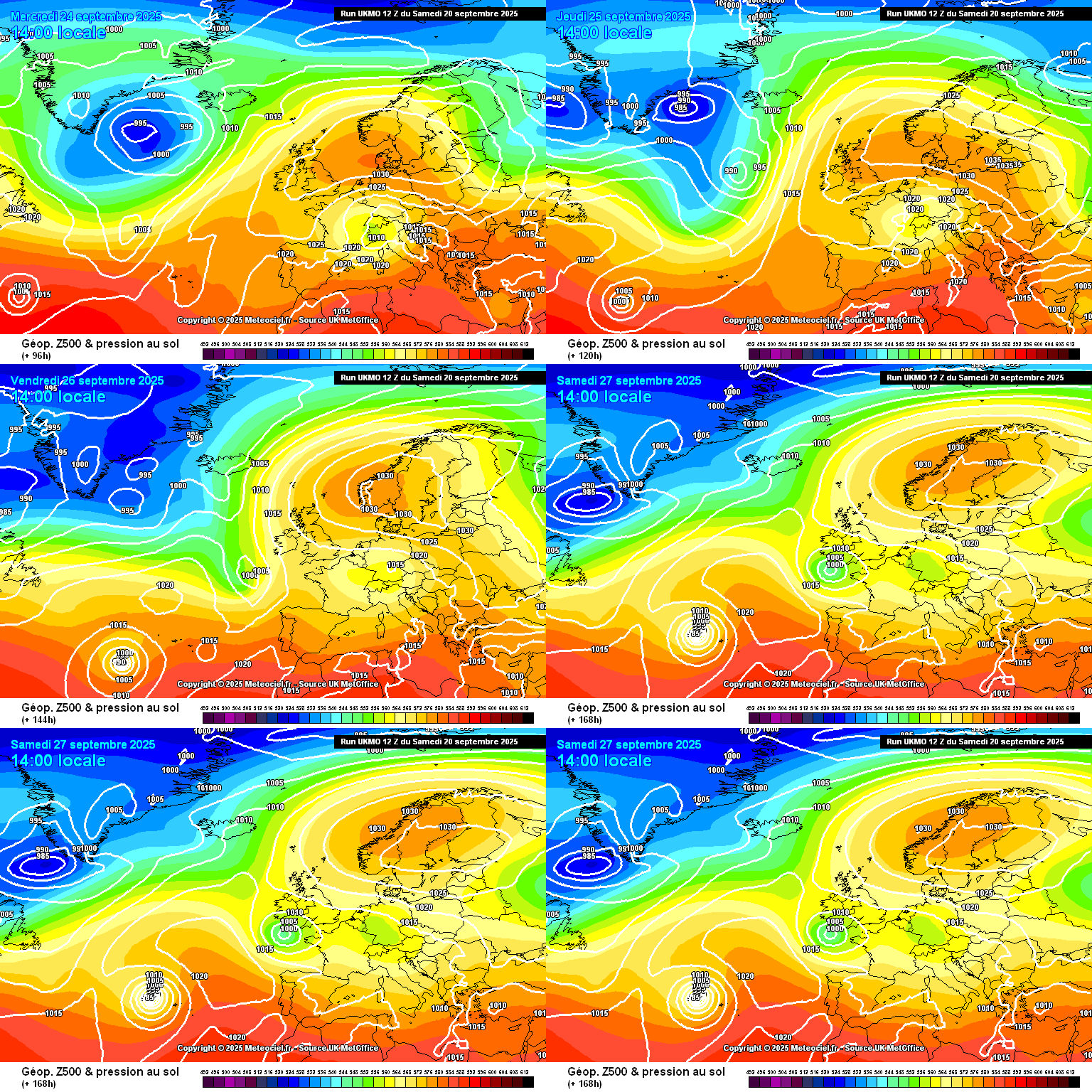
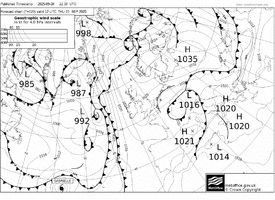
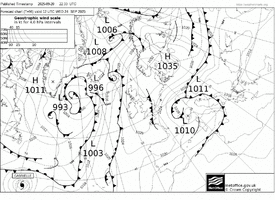
UKMO tem uma trajectória E/ENE e um vale ainda em cavamento para as 12:00 de dia 25.
 

Anexos

  • MetOffice_20250920_0925-12h_T+120.gif
    MetOffice_20250920_0925-12h_T+120.gif
    76.7 KB · Visto: 19
  • MetOffice_20250920_0924-12h_T+96.gif
    MetOffice_20250920_0924-12h_T+96.gif
    75.8 KB · Visto: 22
O ECM já por 2 vezes colocou o ciclone em transição por com da região. De vez em quando há uma saída mais manhosa A última saída do ECM saiu completamente desfasada das outras. Provável devaneio momentâneo.

Relativamente à intensidade e possível trajetória, tal como o @Orion já disse, o cavado irá ter o papel chave.
 
000
WTNT42 KNHC 212051
TCDAT2

We are fortunate to have three NOAA aircraft (two P3's and one G-IV)
which are conducting research missions into Gabrielle this
afternoon. The data they have provided has been valuable, showing
the storm has become better aligned in the low to mid-levels
compared to this morning, though the eyewall structure has been
coming and going due to occasional dry air mixing out near the
cyclone's core. The highest 750 mb flight-level winds were up to 70
kt, which using a typical 0.85 reduction supports 60 kt. However,
the Tail Doppler Radar (TDR) on board one of the NOAA-P3 aircraft
showed a swath of 0.5 km winds up to 79 kt in the eastern semicircle
at 1741 UTC. Using a more conservative 0.80 reduction factor
for this level supports an intensity of 65 kt, and Gabrielle has
become a hurricane.

Recon fixes this afternoon show that the hurricane is beginning to
turn more north-northwest, with the estimated motion now at
330/9-kt. The track reasoning in the short-term remains the same as
this morning, with Gabrielle rounding the western edge of the
subtropical ridge, which should allow the hurricane to turn
northward and then northeastward over the next couple of days. There
was another small adjustment west in the track over the next 24 h,
but this still keeps Gabrielle's wind field well to the east of
Bermuda when it passes its latitude towards the end of the day
Monday. Thereafter, the hurricane should begin to gradually
accelerate in the westerly flow around the north side of the
aforementioned ridge. The biggest change in the track forecast
towards the end of the period is that the guidance continues to
shift a little more southward, especially the most recent 12 UTC
ECMWF, which shifted closer to the Azores in 4-5 days. For now,
the NHC track forecast will only be shifted a little southward this
cycle, choosing to stay closer to the reliable consensus aids TVCN
and HCCA, though it's possible some southward adjustments will
be needed in subsequent forecasts.

While the structure of Gabrielle on geostationary satellite is still
a little ragged with warmer cloud tops than this morning, it has
become more axis-symmetric, and a recent AMSR2 microwave pass at
1733 UTC indicates a thicker 37-GHz cyan ring than the one observed
this morning. 18 UTC DTOPS guidance, which did well predicting
Erin's rapid intensification period earlier this year, is now
indicating a 62 to 76 percent chance of a 30 kt increase in
intensity over the next 24 h. Thus, I see no reason to not forecast
continued steady to rapid intensification over the next 24-36 h,
which is in line with the higher end of the intensity guidance, but
not as high as the most recent HAFS-A run. After 36 h, SHIPS
guidance shows southwesterly shear steadily increasing, and this
should lead to steady weakening through the end of the forecast
period. There is still some question as to Gabrielle's structure at
the end of the forecast and whether it will be losing tropical
characteristics. The southward shift in the forecast track suggests
it might hang on to tropical characteristics a little longer than
originally expected. The intensity forecast falls back close to the
IVCN and HCCA consensus aids by the end of the forecast period.


KEY MESSAGES:

1. Gabrielle is now a hurricane, but is still expected to pass east
of Bermuda on Monday. While the chances of impacts are still
decreasing, interests on Bermuda should continue to monitor forecast
updates since some wind and rainfall impacts are still possible.

2. Swells generated by Gabrielle will continue to affect Bermuda
during the next few days. These swells are now reaching the east
coast of the United States from North Carolina northward, as well as
Atlantic Canada, and should continue through early this week. These
swells are likely to cause life-threatening surf and rip current
conditions. Please consult products from your local weather office.

$$
Forecaster Papin

FORECAST POSITIONS AND MAX WINDS

INIT 21/2100Z 28.5N 61.7W 65 KT 75 MPH
12H 22/0600Z 29.7N 62.2W 80 KT 90 MPH
24H 22/1800Z 31.2N 62.0W 95 KT 110 MPH
36H 23/0600Z 32.7N 60.6W 100 KT 115 MPH
48H 23/1800Z 34.2N 57.7W 90 KT 105 MPH
60H 24/0600Z 35.2N 53.4W 80 KT 90 MPH
72H 24/1800Z 35.8N 47.6W 70 KT 80 MPH
96H 25/1800Z 37.5N 36.0W 60 KT 70 MPH
120H 26/1800Z 41.5N 25.1W 55 KT 65 MPH

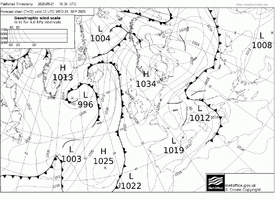
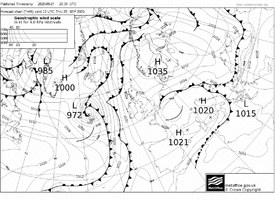
UKMO 12z
MetOffice_20250921_0925-12h_T+120.gif
 

Anexos

  • MetOffice_20250921_0924-12h_T+72.gif
    MetOffice_20250921_0924-12h_T+72.gif
    72.9 KB · Visto: 14
  • MetOffice_20250921_0925-12h_T+96.gif
    MetOffice_20250921_0925-12h_T+96.gif
    75.3 KB · Visto: 13
Última edição:
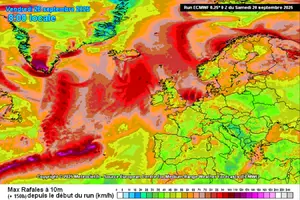
ECMWF 12z, rajadas máximas a 10m de Gabrielle, no canto inferior esquerdo da carta, até dia 29 às 12:00 (depois desta data/hora as rajadas máximas previstas seriam iguais ou inferiores a outras anteriores).

ecmwf-32-192_VMáx-acumul_12z.webp


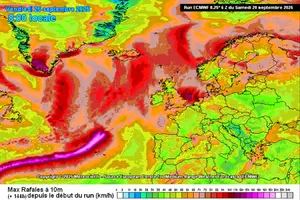
Depois de Gabrielle um eventual novo ciclone tropical teria aquele rasto de rajadas máximas que se observa nesta carta de previsão acumulada até dia 6 de Outubro
ecmwf-32-360_VMáx-acumul_12z.webp
 
Gabrielle é furacão:
"272
WTNT42 KNHC 220247
TCDAT2

Satellite imagery shows that Gabrielle's core convection has started
to wrap up and become a bit more impressive-looking. The latest
subjective and objective intensity estimates still range from about
55-68 kt, so the intensity is held at 65 kt for this advisory. Some
minor adjustments were made to the wind radii based on a 22/0052 UTC
ASCAT-C pass.

The motion is estimated to be northwestward, or 325 degrees at 10
kt. A turn to the north-northwest is expected overnight with a
northward turn expected on Monday as Gabrielle rounds the western
part of the subtropical ridge, and model guidance is in excellent
agreement on the first 36 hours of the track forecast. There was a
very small westward adjustment to the track forecast, but the latest
ASCAT data, which shows that tropical-storm-force winds extend
outward no farther than 60 n mi in the western semicircle, strongly
indicate that the tropical-storm-force wind field will remain well
to the east of Bermuda when Gabrielle makes its closest approach to
the island late Monday. Thereafter, the cyclone will accelerate
east-northeastward within the mid-latitude westerlies. Mainly minor
adjustments were made to the official track forecast, but it should
be noted that beyond day 3, there is a large spread in the guidance,
and confidence in the track forecast is low at that time range.

Gabrielle is expected to strengthen over the next 24 hours,
especially given how warm the waters are. However, the amount of
strengthening that will occur is uncertain due to moderate westerly
wind shear that may affect Gabrielle. For now, the NHC forecast
will continue to show rapid intensification over the next 24 hours
given the recent improvement noted in the inner-core structure,
mentioned above. The NHC forecast during this period is in
agreement with a blend of the HAFS/HMON/HWRF/HCCA models. By late
Tuesday, steady weakening is expected as wind shear increases,
Gabrielle moves into a drier environment, and water temperatures
begin to decrease along its path. The intensity forecast from Day 2
onward is a blend of the previous NHC forecast with the latest
intensity consensus, which is slightly stronger than the previous
NHC prediction.

Beyond day 4, there is a very large spread among the models as to
Gabrielle's track, intensity, and whether or not it will be starting
to attain extratropical characteristics. Therefore, it is too early
to predict what, if any, impacts Gabrielle could have on the Azores.


KEY MESSAGES:

1. Hurricane Gabrielle is expected to pass east of Bermuda on
Monday. While the chances of impacts are still decreasing, interests
on Bermuda should continue to monitor forecast updates since some
wind and rainfall impacts are still possible.

2. Swells generated by Gabrielle will continue to affect Bermuda
during the next few days. These swells are now reaching the east
coast of the United States from North Carolina northward, as well as
Atlantic Canada, and should continue through early this week. These
swells are likely to cause life-threatening surf and rip current
conditions. Please consult products from your local weather office.


FORECAST POSITIONS AND MAX WINDS

INIT 22/0300Z 29.2N 62.2W 65 KT 75 MPH
12H 22/1200Z 30.4N 62.3W 85 KT 100 MPH
24H 23/0000Z 32.0N 61.6W 100 KT 115 MPH
36H 23/1200Z 33.5N 59.5W 95 KT 110 MPH
48H 24/0000Z 34.7N 56.2W 90 KT 105 MPH
60H 24/1200Z 35.5N 51.3W 80 KT 90 MPH
72H 25/0000Z 36.2N 45.6W 75 KT 85 MPH
96H 26/0000Z 39.0N 33.3W 60 KT 70 MPH
120H 27/0000Z 42.7N 23.1W 55 KT 65 MPH


$$
Forecaster Hagen "